Tutoring, Extra Lessons, and Remedial Support
What is the difference and why it matters
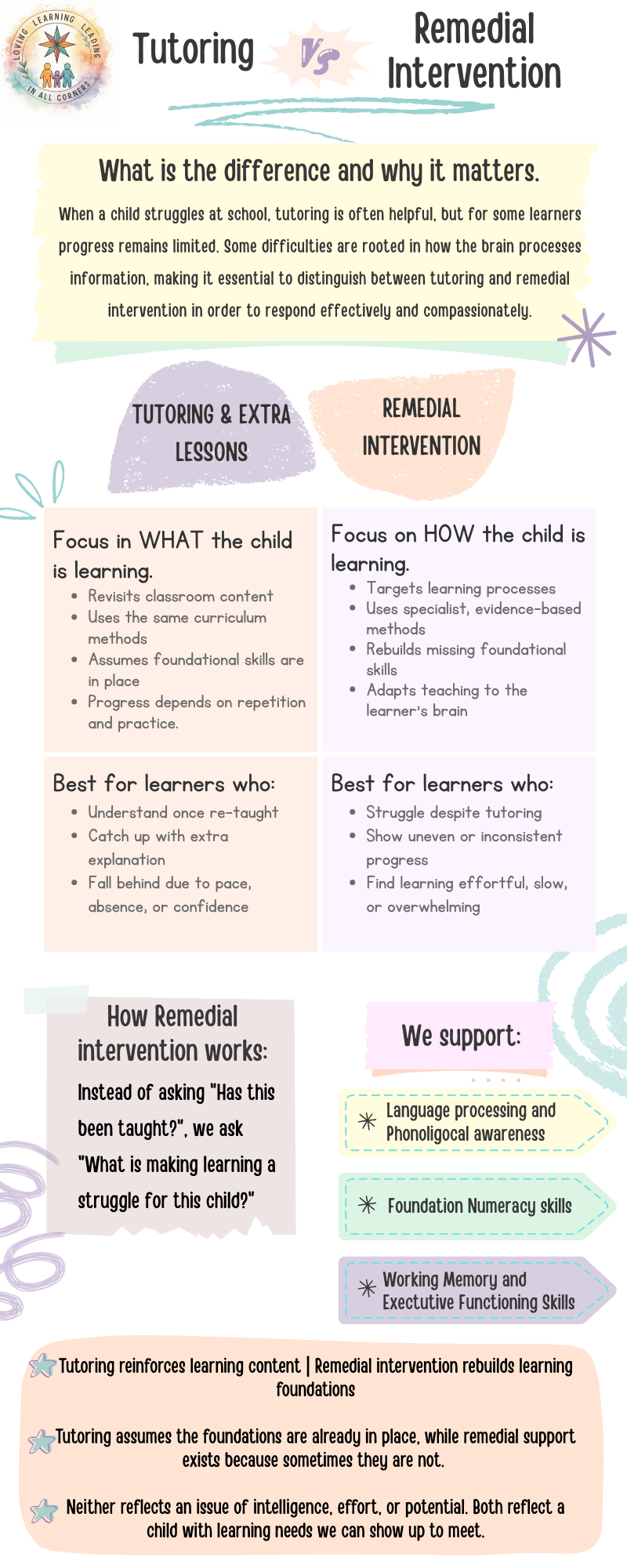
When a child begins to struggle at school, one of the most common recommendations a parent receives is the addition of extra lessons. If this doesn't achieve results, teachers usually suggest one on one tutoring next. For some children, this is exactly what they need. But for others, extra lessons don’t lead to meaningful or lasting progress, no matter how much effort is invested.
This is because not all learning difficulties are caused by gaps in learning, teaching or exposure. Some are rooted in how the brain processes information, along with other learning barriers and these require a different kind of support. Understanding the difference between tutoring and remedial intervention helps families and schools respond earlier, more effectively, and more compassionately.
Tutoring and Extra Lessons: Reinforcing Curriculum Content
Tutoring and extra lessons usually focus on what is being taught in the classroom. They are most effective when a child has fallen behind due to pacing, missed schooling, or transitions. These children usually understand the concepts once they have been explained clearly. They usually just need an extra hand consolidating the curriculum content and benefit from some practice and repetition.
A typical tutoring session usually follows the same type of structure or methodologies. Classroom content is usually re-explained, often using verbal teaching styles or written explanations and demonstrations. From here children are usually given practice activities to work through to reinforce the concepts and demonstrate their level of mastery. Sometimes a tutor will supervise and support a child through their homework in their weak areas and often tutors will assist children in revising concepts for tests. Test revision usually consists of practise exercises or mock tests.
When a child has intact foundational learning skills, tutoring is often enough.
When Extra Lessons Don’t Lead to Progress
For some children, however, difficulties persist despite tutoring and extra learning time. Parents, tutors and educators may notice the same concepts needing to be re-taught repeatedly, slow, effortful reading or writing, difficulty retaining information from one lesson to the next, increasing frustration, avoidance, or fatigue and slow progress that does not match the effort the child is putting in.
These patterns often indicate Specific Learning Disabilities (SLDs - Dyslexia, Dyscalculia, Dysgraphia etc), Executive Functioning difficulties (common in children with ADHD and ASD), or other barriers to learning such as language disorders, motor planning and coordination disorders, socio-economic barriers, medical conditions etc. When faced with barriers to learning that are more complex than missing a few days of instruction and needing to catch up, children require structured remedial intervention, not just more practice.
Remedial Support: Addressing the Foundations of Learning
Remedial support is a specialised, evidence-based and individualized intervention that targets how learning happens, rather than simply reinforcing school content.
Each child’sintervention is structured based on their unique needs. Remedial educators and therapists are trained to identify where learning needs additional support, understand why this support is needed, and explicitly and systematically build or strengthen weak foundational skills. Good remedial support draws from the knowledge and expertise provided by all role players on a child team to understand all areas of struggle a child may face in order to build interventions that use the child's strengths while accommodating and building up areas of struggle.
Evidence-Based Methods Used in Common Remedial Intervention
Unlike standard tutoring and teaching practices that focus on practice and repetition, remedial strategies take into account the cognitive and processing variations of the child. In doing so, teaching is structured systematically, scaffolding support as need be, while teaching using methods that are explicit, multisensory and cumulative. Many language and numeracy “rules” that are not explicitly taught in practice and repetition models but they make sense! They help create guidelines that can be followed, and are common in remedial interventions.
Dyslexia (Reading & Spelling)
Dyslexia is a language-based learning disability affecting phonological processing, decoding, and spelling. Research consistently shows that dyslexia does not resolve through exposure, more reading, or general tutoring. We can, however, help a dyslexic student navigate reading and spelling challenges.
Effective remedial approaches include:
- Structured Literacy instruction
- Explicit teaching of sound-symbol relationships
- Explicit teaching of phonic and language rules
- Multisensory learning (visual, auditory, kinaesthetic)
- Sequential, cumulative skill building
- Frequent review and mastery-based progression
These methods are characteristic of approaches such as Science of Reading and Orton Gillingham based instruction, which are supported by cognitive and neuroscientific research. Structured literacy intervention can alter and develop neural activation patterns in struggling readers, improving accuracy and efficiency. And honestly, having traveled the practice and repeat road of instruction as a child, it just makes more sense.
Dysgraphia (Writing & Written Expression)
Dysgraphia affects a person’s ability to produce written language. It impacts the process of writing and is not associated with a child's intelligence, motivation, or understanding.
Writing is one of the most complex academic tasks. It requires motor coordination, organising thought into written form using accurate language conventions, memory, planning, and self-monitoring to work together. Dysgraphia occurs when one or more of these systems don't work together. Dysgraphia often involves weak fine motor control, poor letter formation, difficulty organising ideas on paper, high cognitive load during writing tasks leading to fatigue and avoidance.
Remedial strategies include:
- Explicit handwriting instruction
- Breaking writing into separate skills (planning, sentence structure, transcription)
- Use of visual frameworks and scaffolds
- Reducing cognitive load so ideas can emerge
- Integrating assistive tools where appropriate
Research shows that writing is a complex integration of motor, language, and executive skills and each must be explicitly supported when weak. Dysgraphia is an output barrier, not a thinking barrier.When we remove the output barrier, learning becomes visible.
Dyscalculia (Maths & Number Sense)
Dyscalculia is a specific learning difference that affects a person’s ability to understand, process, and work with numbers. It impacts how numerical information is interpreted, stored, and used and is not a reflection on a child's intelligence or effort.
Maths is more than memorising facts. It requires number sense, memory, language, visual-spatial skills, reasoning, and sequencing to work together. Dyscalculia can show up as: weak number sense (difficulty understanding quantity, number size, order, place value, and estimating amounts or time), difficulty learning and applying calculations (challenges with basic maths facts, selecting the correct operation, and performing calculations accurately without relying heavily on counting), working memory and processing challenges (forgetting steps in multi-step problems, slow recall of maths facts, and reduced speed when completing maths tasks), visual–spatial and symbol confusion( difficulty recognising and distinguishing numbers, aligning work correctly, and interpreting visual maths information such as graphs or charts), difficulty with efficiency and accuracy under pressure (increased errors, loss of strategies, or task breakdown when tasks are timed, complex, or cognitively demanding). There is so much that goes into acquiring and building mathematical competency and if one foundational gap is present, the whole tower falls. The internal pressure a person navigating these vulnerabilities must feel incredibly overwhelming.
Evidence-based remedial methods include:
- Concrete, representational and abstract (CRA) teaching
- Hands-on manipulatives and visual models
- Explicit instruction in mathematical language
- Slower pacing with repeated concept reinforcement
- Supporting working memory and planning alongside maths
When number sense and executive skills are addressed together, we see improved outcomes for dyscalculia. With the right strategies a child with dyscalculia can build meaningful mathematical understanding and use maths successfully.
Executive Functioning Difficulties
Executive functioning refers to skills that help us plan, organise, start, manage, and complete tasks. These skills act like the brain’s management system, they don’t give us information, but they help us use what we know effectively. Executive functions are largely supported by the prefrontal cortex which is underdeveloped in children and continue to develop well into early adulthood. Children with ADHD and Autism commonly struggle with exectuve function. These struggles can look like: poor attention or task initiation, forgetting instructions or forgetting the pieces of information your brain is working with to complete a task, disorganisation, difficulty planning or monitoring work, emotional overwhelm during learning and impulsivity.
Executive functioning is not explicitly taught in the classroom as “typically developing” children usually pick up these skills as they grow.
Remedial strategies include:
- Explicit teaching of planning and organisational strategies
- Visual supports, checklists, and routines
- Breaking tasks into manageable steps
- Metacognitive coaching (“how do I approach this?”)
- Practising strategies across contexts until they generalise
Dyspraxia and Coordination Disorders
Dyspraxia, also known as Developmental Coordination Disorder (DCD), is a neurodevelopmental difference that affects a child’s ability to plan, sequence, and coordinate their movements. This can impact everyday tasks such as handwriting, using tools, participating in sport, and managing classroom routines. In these situations, the brain requires more support to organise and carry out motor actions efficiently.
Dyspraxia may show up as: clumsiness or awkward movements, difficulty copying or sequencing movements, difficulty with handwriting and fine motor tasks, struggling with multi-step tasks, taking longer to complete tasks or avoiding them. Everyday movement we perform without even thinking can feel challenging and effortful for someone with dyspraxia.
Effective remedial strategies include:
- Task-oriented intervention, where children practise meaningful, real-life activities (such as handwriting or classroom tasks) broken down into manageable steps
- Cognitive and problem-solving approaches (e.g. teaching children to plan, try, and review how they complete a task) to support motor planning and independence
- Multisensory cueing, using visual, verbal, and physical prompts to help the brain integrate information and guide movement
- Environmental and task adaptations, such as reducing time pressure, modifying tools, and offering alternative ways to show learning
- Repetition with variation, allowing skills to be practised in supportive, motivating ways that encourage confidence and carryover
These approaches are supported by research showing that children with dyspraxia learn best when intervention is functional, goal-directed, and explicitly taught. By reducing unnecessary motor load and building planning strategies, remedial support allows learners to access the curriculum more effectively. We support dyspraxic learners not to “fix” them, but to honour how their brains work, creating pathways for success, independence, and self-belief.
A Crucial Distinction
Many of the remedial and support strategies mentioned above do not fall into the knowledge and experience of standard tutors and teachers. Those of us offering remedial interventions have an educational or psychological base of knowledge that we have built upon. Adding to our expertise by means of additional studies, training or experience by means of mentorships with other remedial specialists. This is one of the reasons remedial interventions cost more than standard tutoring. Specialist training in learning disabilities, understanding and/or performing diagnostic observation and profiling, individualised programme design based on profiles,evidence-based instructional methods and ongoing progress monitoring and adaptation are the areas we differ from standard tutors. Many remedial specialist also have experience working as part of a multi-disciplinary team, often meeting with and taking insight from a child's various support specialists in order to ensure goal alignment and prevent confusion that may inhibit progress. We support each other without overshadowing one another.
At the end of the day:
Our goal is not short-term academic improvement, but lasting change in how a child accesses learning.
I am not saying extra lessons and tutoring are not beneficial, they absolutely are! However, we need to understand the distinction between tutoring and remedial intervention as well as the difference between a child who just needs a tutor and a child who is in need of more in depth intervention to succeed.
In closing, here is a simple way to summarise the difference:
Tutoring reinforces learning content | Remedial intervention rebuilds learning foundations
Tutoring assumes the foundations are already in place, while remedial support exists because sometimes they are not.
If a child is continuously improving with repetition and explanation, then tutoring is sufficient.
If there is little to no progress or it only occurs once the teaching method changes, then remedial intervention is needed
Neither reflects an issue of intelligence, effort, or potential. Both reflect a child with learning needs we can show up to meet.
References & Evidence Base
- International Dyslexia Association (IDA) – Structured Literacy
- Snowling, M. & Hulme, C. (2012). Interventions for children’s language and literacy difficulties
- Shaywitz, S. (2003). Overcoming Dyslexia
- Butterworth, B. et al. (2011). Dyscalculia: From brain to education
- Meltzer, L. (2018). Executive Function in Education
- National Reading Panel (2000)
- American Academy of Pediatrics – Learning Disabilities
- Willingham, D. (2009). Why Don’t Students Like School?
- Reading and White Matter Development: A Systematic Review of Neuroplastic Changes in Literacy
Infographic